Updated: July 2026
Ambon and the Spice Route: A Walking History You Can Still Taste
Why empires rose and fell over an Ambon island.
The nutmeg trade that built the Dutch Republic. The Banda massacre that broke Maluku. What’s left, and where to find it on a walk through the city. (See Banda Sea (Smithsonian) for context.)
Until 1817, every nutmeg seed in the world came from one of ten small islands in the Banda Sea. Three of those islands you can see from the deck of an Ambon liveaboard. The trade in those seeds — and the Mace, the dried aril of the same nutmeg fruit — built the Dutch East India Company into the wealthiest corporation in human history, then bankrupted it, then redrew the map of Southeast Asia three times.
Most divers come to Ambon for the reefs and discover this history by accident, usually at dinner with the boat captain. We think it’s worth coming for either reason. Here’s the short version, and where on the island you can still see it.
The fruit that started it all
Nutmeg is the seed of Myristica fragrans, a tree that grew naturally only in the Banda Islands. For most of recorded history, nobody outside Maluku knew where it came from — Arab and Indian traders bought it at Indonesian ports and sold it on without revealing the source.
In 14th-century Europe, an ounce of nutmeg cost more than an ounce of gold. Plague-era Europeans believed it warded off the Black Death (it didn’t, but the demand was real). When Portuguese ships finally located the Banda Islands in 1512, the chase to control them became the central event of the Age of Exploration.
The VOC arrives
The Dutch East India Company (VOC) was founded in 1602 specifically to break the Portuguese monopoly on the spice trade. By 1605 they had taken Ambon. By 1621 they had — under VOC governor Jan Pieterszoon Coen — committed what is now called the Banda Massacre, killing or deporting roughly 90% of the indigenous Bandanese population to enforce a cartel on nutmeg pricing.
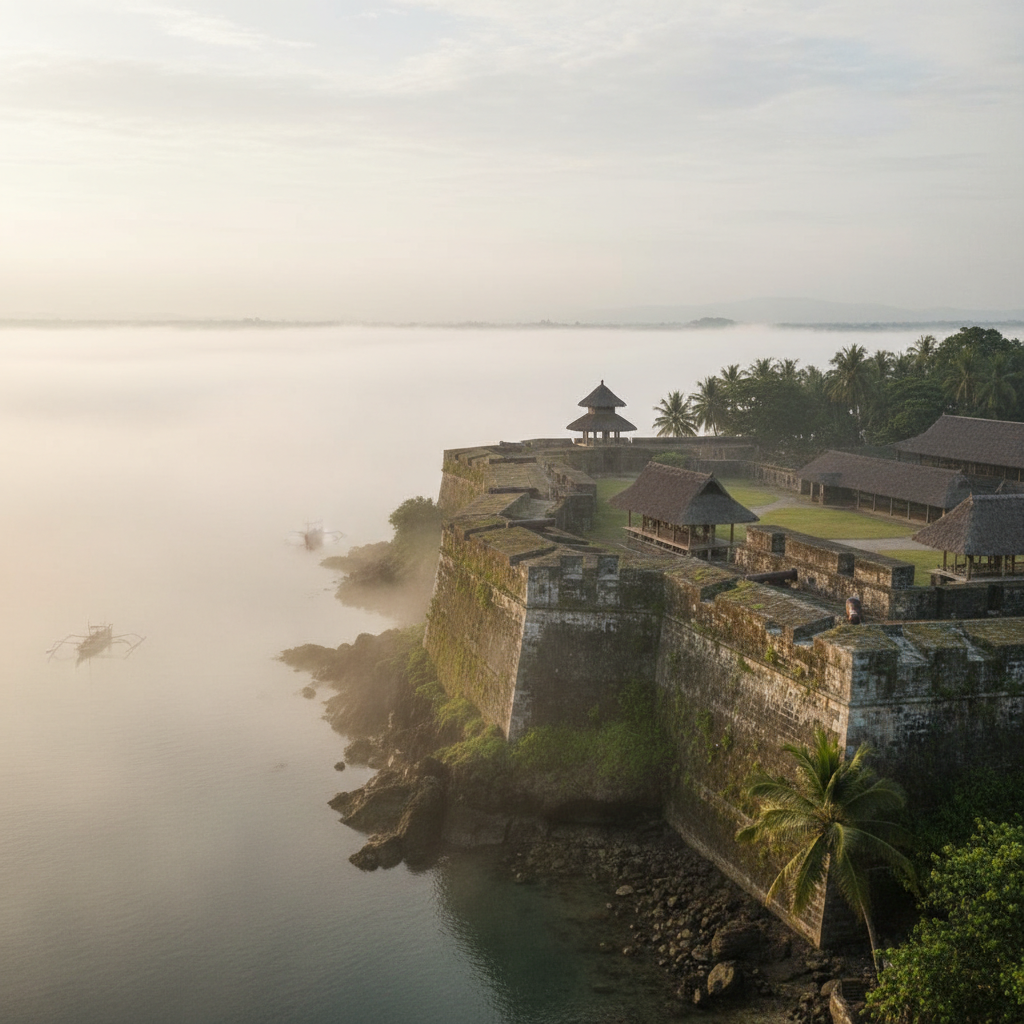
The remaining nutmeg groves were taken over by Dutch perkeniers — landowners worked by enslaved labor from across the archipelago. For two centuries, Ambon was the administrative capital of this trade. Fort Victoria, built by the Portuguese in 1575 and rebuilt by the Dutch, sat directly above the harbor where every barrel of nutmeg was loaded.
What broke the monopoly
In 1817, a French agent named Pierre Poivre smuggled nutmeg seedlings out of the Banda Islands to French Mauritius. Within a generation, nutmeg was being grown in Grenada, Zanzibar, and India. The Banda monopoly collapsed. Prices crashed. The VOC, which had been declining for decades, was formally dissolved.
Ambon stayed culturally tied to its trading history but lost its economic centrality. Through the 20th century it was a quiet provincial capital — Indonesian independence in 1945, the Maluku sectarian conflict 1999-2002, and eventual reconstruction. The harbor still works. The nutmeg groves still produce. The fortifications are still standing.
A walk through what’s left
Fort Victoria. 30-minute walk from the harbor. Restored exterior, museum inside. Free to enter. The seaward bastion gives the best view of Ambon Bay — exactly the view that VOC governors had when they counted nutmeg shipments.
Pattimura Statue. Centerpiece of the city center, commemorating the 1817 uprising led by Thomas Matulessy (“Pattimura”) against Dutch reoccupation. Useful symbol of how complicated independence movements got in the spice islands.
Banda Neira (3-day boat trip). Most Ambon liveaboards include 1-2 days on Banda Neira. Fort Belgica (1611, restored) and Fort Nassau (1609, ruin) sit on the same hillside, both visible from the diving sites at Pulau Run. The current population of Banda Neira is roughly 7,000 — about a third of what it was before the 1621 massacre.
Run Island. The smallest of the inhabited Banda Islands. In 1667, England and Holland signed the Treaty of Breda — England gave up Run, Holland gave up Manhattan (then called New Amsterdam). Both sides thought they got the better deal. Today Run is a tiny fishing village, no electricity until 2018, accessible only by boat. We dive its outer wall on day six of the standard route.
The taste, still
The clearest way to encounter the spice route in Ambon is at the table. Local cooking still uses nutmeg, mace, cloves, and pepper — all four of the spices that made the trade — at concentrations you don’t find elsewhere in Indonesia. Try papeda (sago dumplings) with kuah ikan kuning (turmeric-and-clove fish broth). Try kasbi rebus with grated nutmeg. The grocery in central Ambon sells Banda Islands nutmeg by the kilo at prices that would have started a war 400 years ago.
Combine diving with the Banda Neira walking tour
Our standard 7-day voyage includes the Banda Neira land excursion at no extra cost. We can extend by 2 days for a deeper history walk on request.
The strategic heart of the Spice Trade: Forts and colonial echoes
Step onto Ambon Island, and the whispers of empires past greet you, carried on the very breezes that once filled the sails of spice-laden galleons. This island, roughly 775 square kilometers (300 sq mi) of lush volcanic landscape, was not merely a stopover; it was the coveted prize in a global scramble for wealth. Here, the strategic importance of the Maluku Islands, the original “Spice Islands,” is palpable in the enduring architecture of its colonial past. The Portuguese, the first Europeans to arrive, quickly recognized Ambon’s pivotal position, establishing a trading post and fortress.
Dominating the harbor, Fort Victoria stands as a formidable testament to this era. Originally constructed by the Portuguese in 1575, it was later seized and expanded by the Dutch East India Company (VOC) in 1605, becoming their primary stronghold in the region for centuries. Walking through its ancient gates, past its thick stone walls and cannon emplacements, offers a profound journey back in time. Imagine the bustling trade, the political intrigue, and the fierce battles that unfolded within and around these very ramparts, all driven by the insatiable demand for nutmeg and cloves. For the discerning traveler, a private guided tour of Fort Victoria provides an opportunity to examine these captivating narratives with expert insights.
Beyond the fort, the city of Ambon itself reveals layers of history. Elegant colonial buildings, some still standing in various states of preservation, line streets that once buzzed with merchants from across the globe. Exploring these architectural remnants offers a vivid sense of the grandeur and ambition of the European powers. These structures, juxtaposed with vibrant local life, paint a picture of an island where history isn’t just preserved in museums, but actively breathes through its daily rhythms, inviting a deeper, more personal connection to its storied past.
A symphony of flavors: Ambon’s culinary spice legacy
While the forts tell tales of conquest, it is the lingering aroma of spices that truly awakens Ambon’s historical soul. The island was, and remains, a vital source of nutmeg and cloves, commodities so valuable they once reshaped global economies. During the 17th century, a pound of nutmeg could be traded for more than 60,000 times its original price in Europe, fueling an era of exploration and intense rivalry. Today, Ambon’s culinary scene offers a direct, delicious link to this opulent past, inviting you to taste the very flavors that launched a thousand ships.
Luxury travelers can indulge in exclusive culinary experiences that highlight Ambon’s spice heritage. From bespoke cooking classes held in private kitchens overlooking the sea, where you learn to infuse local dishes with freshly ground nutmeg and cloves, to dining at high-end restaurants that skillfully blend traditional Malukan recipes with contemporary flair, every meal is an exploration. Savor dishes like “ikan kuah kuning” (fish in yellow soup) subtly spiced with local aromatics, or desserts featuring the island’s signature nutmeg, creating a symphony of sweet and savory notes that dance on the palate.
The bustling Pasar Mardika, Ambon’s main market, provides a vibrant, sensory immersion into the island’s spice culture. Here, mountains of whole nutmeg, mace, and cloves are sold alongside exotic fruits and fresh seafood. Engaging with local vendors, perhaps even purchasing some of these precious spices to take home, offers an authentic connection to a trade that has defined Ambon for centuries. You can also discover local delicacies like “sagu lempeng” (sago flatbread) or “kopi rempah” (spice coffee), each sip and bite a flavorful testament to Ambon’s enduring role as a culinary collection. For more on Ambon’s unique charm, visit Indonesia.travel.